
Will AI take over jobs in health and social care?
Updated: May 27
As artificial intelligence advances rapidly, care home managers, operators, and frontline support staff are all asking the same fundamental questions: What is the future of AI in our sector? Will machines eventually replace human care workers? And where can an organisation turn for practical help to implement these tools safely?
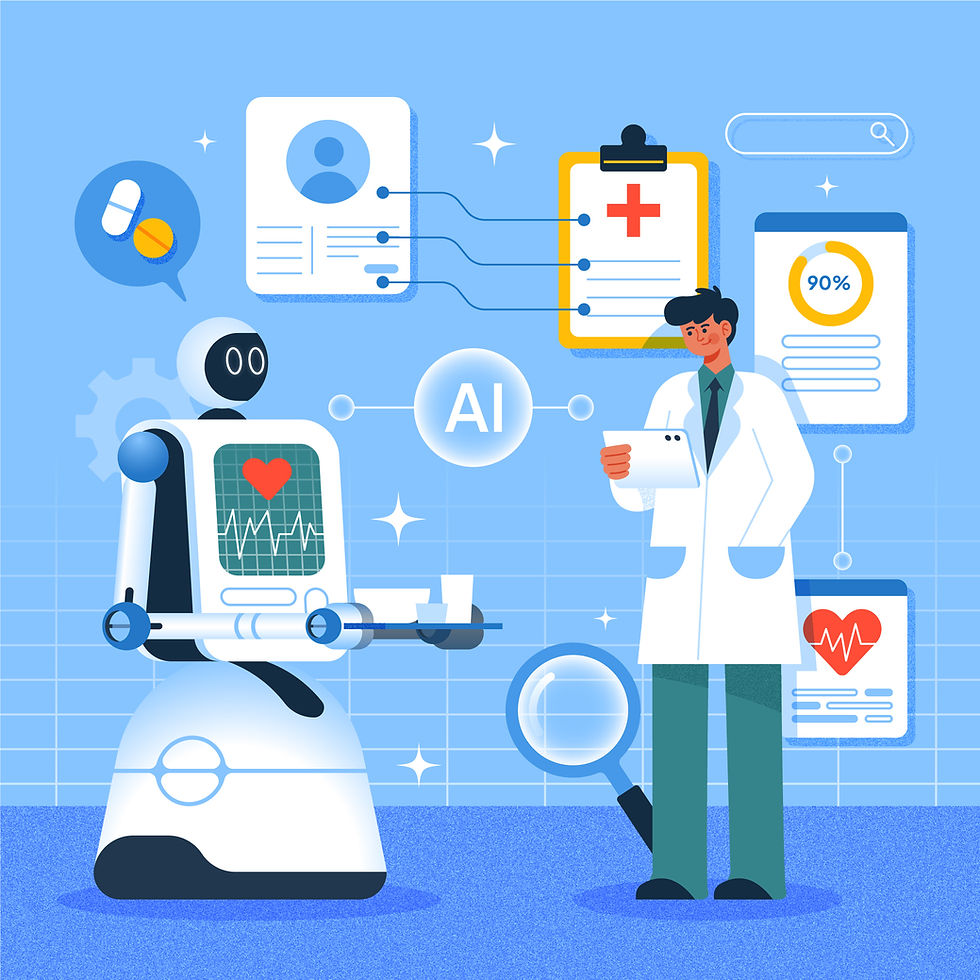
The short answer is no. Health and social care is one of the most uniquely protected sectors against total automation.
While AI excels at processing data, identifying patterns, and handling repetitive admin, it lacks the core traits required for high-quality care: empathy, emotional intelligence, physical dexterity, and real-time human judgement.
Quick Links
Rather than replacing staff, AI will act as a digital co-pilot. By absorbing the heavy analytical and clerical workloads that currently cause widespread staff burnout, AI allows care teams to return to what they love most: delivering hands-on, person-centred care.
The Division of Labour Between AI vs. Human Carers
What AI Can Handle (The Mechanics) | What Only Humans Can Do (The Heart) |
Writing chronological shift summaries. | Sensing when a resident is quietly anxious or lonely. |
Analysing fluid charts for dehydration risks. | Holding a hand during a difficult palliative care moment. |
Predicting fall risks based on sensor telemetry. | Building deep, trusting relationships during companion care. |
Tracking eMAR medication compliance schedules. | De-escalating an agitated client using trauma-informed touch and tone. |
What Does the Future of AI in Care Look Like?
The integration of AI in health and social care is already happening across residential, nursing, and community settings through several key innovations:
Acoustic and Visual Predictive Care
Traditional care workflows are reactive—a carer responds after a resident presses a call bell or suffers a fall. AI transforms this into proactive care.
Advanced acoustic and visual sensors can monitor a vulnerable resident’s room overnight (with appropriate consent), subtly detecting changes in breathing patterns, increased restlessness, or a sudden coughing fit. The AI immediately flags these anomalies, allowing staff to intervene before a medical crisis or a fall occurs.
Automated Note Harmonisation and Dictation
One of the largest drains on a support worker's shift is writing daily logs. Emerging generative AI tools allow staff to verbally dictate their handover notes into a care app at the end of a shift.
The AI instantly cleans up the grammar, strips out subjective language, formats the notes chronologically, and syncs them directly into the client’s digital social care record.
Objective Pain and Distress Detection
For individuals living with advanced dementia or non-verbal communication profiles, identifying physical pain can be incredibly difficult. AI-driven smartphone apps (such as PainChek) can analyse brief facial muscle micro-expressions to objectively assess a client's pain level, ensuring they receive targeted medication and comfort care precisely when they need it.
What Support is Available to Help Care Providers Adopt AI?
If your organisation wants to integrate smart technologies but doesn't know where to start, significant national frameworks, funding pathways, and regulatory guidelines exist to assist you:
The Digitising Social Care Programme (NHS England)
Led by the Department of Health and Social Care and NHS England, this initiative provides direct guidance, grant funding opportunities, and a curated list of Assured Supplier Solutions for Digital Social Care Records (DSCR). Adopting an approved digital system is the vital first step toward implementing advanced AI analytics.
Skills for Care Digital Guidance
As the sector's workforce development body, Skills for Care actively runs an ongoing AI Community of Practice and publishes formal tech-adoption toolkits. Their national workforce strategy directly focuses on improving the digital literacy of care staff, ensuring teams possess the confidence and skills to operate alongside emerging tech tools.
The Care Quality Commission (CQC) Positioning
The CQC explicitly encourages the ethical adoption of AI and digital care management. In their official regulatory updates, they state that innovative technologies are welcomed provided there is always clear human oversight.
The CQC evaluates AI-enabled care through its standard quality indicators, checking that data privacy is protected, staff are fully trained to interpret the technology, and the tools directly improve safe, equitable, and person-centred outcomes.
The JasmynCare Philosophy: Tech-Enabled, Human-Led
At JasmynCare, we embrace the future of care technology because we know it strengthens our workforce. By supporting our staff with modern, streamlined tools and clear compliance pathways, we eliminate the operational friction that leads to burnout.
We don't use technology to replace human touch—we use it to protect it.
Build a future-proof care strategy with a partner you can trust. Whether you are a care provider looking for tech-savvy, highly compliant staffing solutions, or a professional looking to join a forward-thinking care team, JasmynCare is here to lead the way.
Explore our Workforce Solutions today or contact us directly on 0203 432 1942 to discuss a partnership.
To learn more about the evolving landscape of technology in adult social care, watch this discussion on AI and the future of social work practice which explores the integration of digital capabilities and ethical considerations within the adult social care workforce strategy.


Comments